How Proterial Cable America increased non-branded clicks by 147%



How Proterial Cable America increased non-branded clicks by 147%

How AbeTech increased organic visibility by 485%

How Proterial Cable America increased non-branded clicks by 147%

Written by Jill Longworth, Marketing Specialist May 14, 2026
Modern-day logistics marketers are caught between an industry that’s been slow to embrace digital transformation and buyers who increasingly expect technology-driven experiences. While other B2B sectors have fully committed to digital marketing strategies, many logistics providers are finding themselves stuck with outdated approaches that no longer resonate with modern procurement teams.
The companies breaking away from the pack have figured out how to bridge this gap. They’re using a sophisticated marketing strategy specifically designed for an industry where buying committees make complex decisions, sales cycles span quarters or even years, and trust matters more than flashy campaigns. Instead of using the same generic marketing tactics they were using a decade ago, they’re upgrading to customized logistics digital marketing strategies that not only acknowledge the unique realities of B2B logistics but turn them into competitive advantages.
Buyers appreciate innovative digital marketing campaigns, but only when they provide substantive insights into vendor capabilities and industry expertise. The companies that understand this distinction are capturing disproportionate market share through B2B logistics marketing approaches that combine creative execution with operational credibility while meeting evolving customer expectations for immediate, comprehensive information access.
The following sections break down some of the trends defining top logistics marketing strategies today. Use these to ensure your business is staying ahead in the rapidly evolving marketplace.
The majority of logistics marketing dollars chase the small percentage of companies actively seeking quotes, missing the far larger audience that represents tomorrow’s pipeline. These out-of-market prospects represent future opportunities, but they’re not yet in the mindset to convert or engage with traditional lead-generation content.
Zero-click content is content that provides value directly on the platform where it is published, rather than pushing users to your website to get the full picture. This content has no conversion intent, but instead it builds relationships with potential future buyers by delivering valuable insights without requiring anything in return.
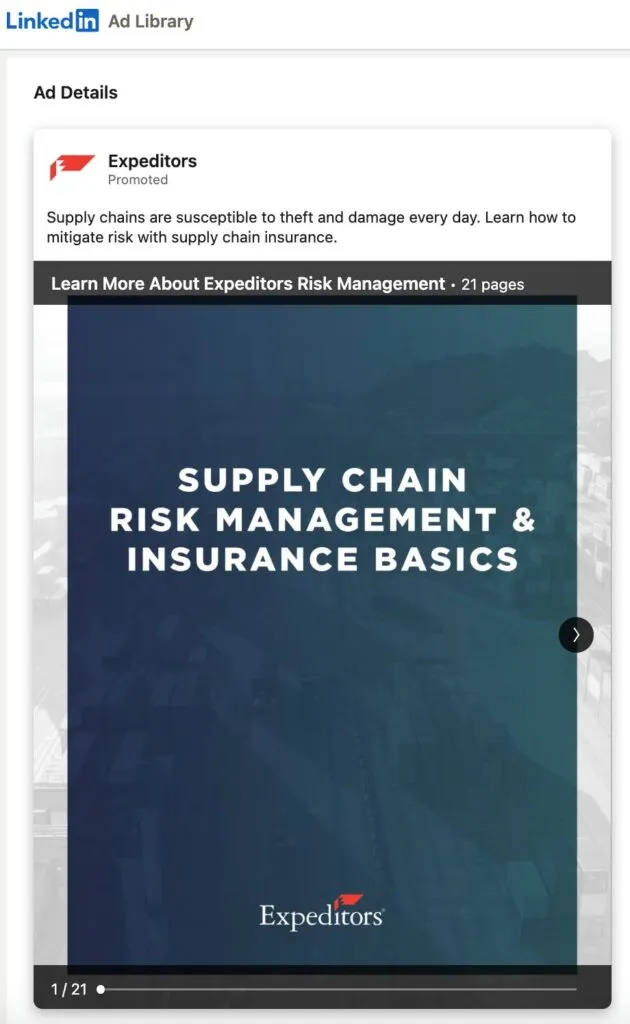
Take the approach shown in this LinkedIn ad from Expeditors. Instead of pushing for a demo or consultation, they’re sharing actionable insights directly in the ad creative. The prospect gets value immediately, and the company builds trust without creating friction. Furthermore, by addressing critical industry pain points like supply chain theft through educational content, Expeditor has positioned itself as the trusted advisor prospects can turn to when they’re ready to make a change.
This second example from XPO demonstrates the same principle by delivering valuable information straight to where their audience already spends their time, with no barriers to consumption. Instead of making their potential customers jump through hoops and visit multiple links to get information, they have it all laid out in one place.

The tactical execution of zero-click content requires marketing teams to restructure their content marketing strategies. This shift also demands deeper collaboration between marketing and sales teams to identify the specific information points that influence vendor evaluation at each stage of the procurement process.
The companies winning with this approach leverage their social media and display advertising as educational opportunities, not just lead generation tools. They’re building audiences of engaged prospects who consume their content regularly, making the eventual sales conversation a natural progression rather than an unwelcome interruption.
Logistics is fundamentally about trust. But trust is abstract, and procurement teams need concrete reasons to choose you over the competition. The leaders in this space have mastered the art of turning their experience into compelling proof points.
For example, Kuehne+Nagel does an excellent job of demonstrating credibility by prominently featuring the number of locations they have worldwide, the number of countries connected by their network, the number of customers they serve, and the number of professionals they employ.

Another example of this can be seen on XPO’s website, wherein they communicate their operational scale by providing concrete numbers like 13,000 Drivers, 44,000+ tractors and trailers, and 99% US ZIP codes covered. Not only that, but XPO further demonstrates its experience by stating in blatant metrics how fast it’s growing as a logistics business and how efficiently it can handle shipments. In doing this, XPO emphasizes its reliability and coast-to-coast network upfront, which provides procurement teams with an immediate understanding of the value of their logistics services.

This digital marketing strategy works well because logistics buyers are inherently risk-averse. They’re not looking for the flashiest solution; they’re looking for the safest bet. These industry leaders are not simply offering empty promises or fluff-filled “we’re the leading company” statements; they’re proving their expertise with cold. Hard. Stats.
Logistics companies operate across global time zones, and complex service inquiries sometimes require immediate responses outside traditional business hours. Implementing AI chatbots in this sector goes beyond basic lead generation to provide substantive pre-sales support that mirrors what prospects expect from logistics partnerships.
DHL’s “Aida” chatbot represents a sophisticated implementation of this technology. Rather than trying to replace human interaction entirely, they’re using AI to handle the routine questions that bog down their customer service like tracking requests, basic rate inquiries, and documentation questions. By automating these interactions, DHL enhances the overall customer experience while freeing up its human team members to focus on the relationship-building conversations that actually drive revenue.

Implementation requires integration with existing CRM systems, warehouse management systems, and pricing platforms to ensure chatbot responses reflect current capacity, routing options, and pricing structures. The most effective use of chatbots leverages predictive analytics and machine learning algorithms trained on historical inquiry data to anticipate a customer’s needs and proactively provide relevant information.
The companies seeing the biggest returns from AI chatbots are those that view them as qualification tools rather than replacement tools. The bot handles the initial inquiry, gathers relevant information, and routes qualified prospects to the appropriate human team member with full context.
This approach ensures that your salespeople are having meaningful conversations with prospects who are already partially qualified and educated about your capabilities. All in all, implementing a chatbot can help you better conduct market research while improving overall customer satisfaction.
Complex logistics operations lend themselves naturally to powerful visual storytelling, which demonstrates capabilities far more effectively than traditional digital marketing materials. High-production video content enables logistics companies to effectively showcase their physical infrastructure, technology integration, inventory management systems, operational scale, and company values in a way that resonates with procurement teams evaluating vendor capabilities.
Nippon Express’s “Meet NX Group: Connecting the World” video demonstrates this approach by briefly explaining their company history and vision while providing visual proof of global supply chain operations and technological sophistication. Rather than describing capabilities in wordy long-form content, the short-form video format allows prospects to understand their company and its operations in just one minute.

Ryder’s “Innovation Advantage” video takes a different approach, focusing more on what the company has to offer in terms of technology integration, delivery process, and fleet and supply chain management capabilities rather than broad brand messaging. This type of content addresses some of the procurement’s key evaluation criteria: continued innovation, reliability, and the ability to scale with business growth.

Remember that making the investment in production quality will send a signal about your overall approach to business. Companies that invest in professional video content are communicating that they invest in quality across all aspects of their operations. This attention to detail becomes a differentiating factor for procurement teams evaluating potential partners.
The logistics industry is built on expertise. Leading B2B logistics companies have responded by packaging their expertise into comprehensive resource centers that serve as ongoing proof of their knowledge and operational know-how, giving prospects a reason to trust them long before a sales conversation happens.
C.H. Robinson’s resource center demonstrates this strategy through organized content that addresses specific logistics challenges across different industries and service types. Rather than offering generic thought leadership, they’ve created a comprehensive library of content that addresses every stage of the supply chain planning process.
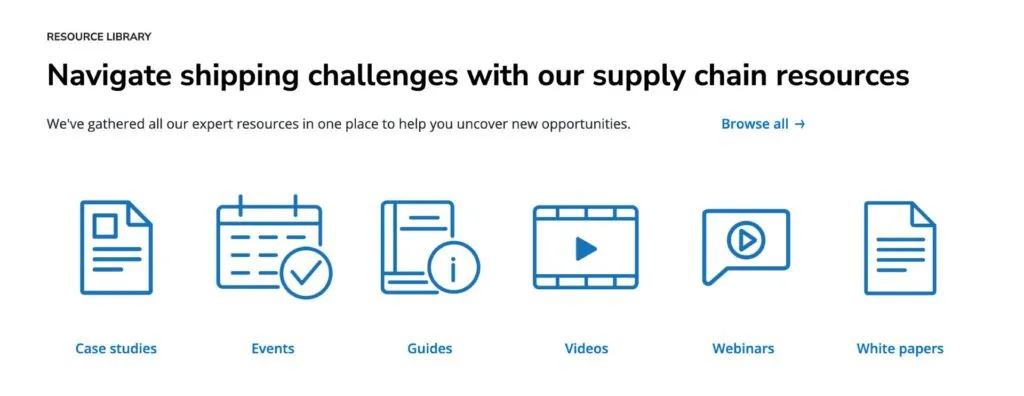
This approach works particularly well in logistics because the industry is constantly evolving. New regulations, trade policies, and technological capabilities create ongoing educational needs for your prospects. By maintaining a comprehensive resource center, you position your company as the authoritative source for industry knowledge.
Resource centers can also function as self-service education platforms that allow prospects to develop vendor preferences through independent research rather than sales-driven interactions. On top of that, SEO optimization of these resource centers ensures you capture prospects actively searching for logistics solutions or researching industry challenges, positioning your brand at the moment when buyers are gathering information.
The companies seeing the biggest returns from this strategy are those that organize their resources around customer problems rather than internal product categories. Instead of separating content by service type, they’re organizing it around customer challenges: cost optimization, compliance management, supply chain visibility, and risk mitigation. Many companies also find success in including gated premium content in their resource centers that supports lead generation while providing genuine value to prospects.
Leading logistics providers leverage webinars as relationship-building tools that improve customer satisfaction while creating opportunities for deeper engagement with their target audience.
Flexport’s webinar strategy demonstrates a good understanding of this approach by addressing current supply chain industry trends and regulatory changes that affect logistics decision-making. Rather than sales-focused presentations, these sessions provide genuine educational value that positions the company as an advisor rather than just another vendor, supporting both lead generation efforts and customer loyalty development.

Another example is Project44 who takes a slightly different route and promotes their webinars through paid channels to reach prospects who might not be following their organic content.

Simple registration data also offers valuable insights into prospect interests and evaluation timelines; and CRM integration ensures webinar engagement data influences lead scoring and sales prioritization decisions.
Some companies take it a step further by implementing follow-up sequences that provide additional resources based on webinar attendance to help maintain engagement throughout extended sales cycles.
The logistics companies implementing these trends successfully share one common trait: they’ve recognized that modern B2B logistics marketing requires specialized expertise that most internal teams simply don’t possess. While your operations team might excel at moving freight and managing supply chains, digital marketing in a commoditized B2B environment demands an entirely different skill set.
Partnering with agencies specializing in industrial digital marketing ensures you gain access to proven strategies while avoiding the common pitfalls of applying consumer or SaaS marketing tactics to logistics lead generation. At Konstruct, we focus on measurable results and key performance indicators rather than vanity metrics, ensuring every dollar spent contributes to pipeline growth and revenue generation.
We’ve developed the GTR (Go-To-Revenue) framework specifically to help industrial companies gain a competitive edge. Our six-playbook system transforms marketing teams from cost centers to revenue drivers through a marketing strategy built for your industry and your company’s unique requirements. Rather than adapting generic B2B tactics, GTR provides logistics companies with the specialized approach needed to compete effectively in an increasingly digital marketplace where operational excellence must extend to marketing execution.
The highest-performing logistics companies are leveraging modern technology and deploying out-of-the-box strategies to separate themselves from the crowded middle tier, which are still relying on traditional marketing methods. Contact us to learn how our industry expertise can help your company break away from the competition.