How Proterial Cable America increased non-branded clicks by 147%



How Proterial Cable America increased non-branded clicks by 147%

How AbeTech increased organic visibility by 485%

How Proterial Cable America increased non-branded clicks by 147%

Written by JD Cutting, Digital Strategy Lead August 20, 2026
Here’s a game I play with manufacturing clients. I pull up three of their direct competitors’ “About Us” pages and cover every obvious giveaway: the logo, the company name, the headquarters city, the founding year, the product names, the leadership headshots, even the office photos. Then I ask them to identify which company is which based on what’s left.
They almost never can.
Because the copy on all three reads roughly the same:
Some version of that paragraph is sitting on a manufacturer’s website right now, probably yours. And it isn’t a copywriting problem, but rather a positioning problem dressed up as a copywriting problem.
If you ran the same test on your own marketing, would your buyers be able to pick you out of a lineup? For most manufacturers, the honest answer is no. That should bother you, because the buyers, the channels, and the math have all shifted in ways that punish anonymity.
Modern manufacturing buyers self-educate. They make 73% of their decision before they ever talk to a sales rep (GreenHat). The buying group they belong to now averages 11 people across engineering, procurement, finance, operations, and the executive bench (6sense). And those buying groups walk into evaluations with a shortlist already in their heads. Bain’s research shows up to 90% of B2B buyers ultimately pick from that “day-one” shortlist.
Translation: if your brand isn’t already living in a buyer’s head before they need you, you’re not in the consideration set. And you don’t get a second chance to make a first impression on someone who never knew you existed.
It gets worse. Being known isn’t enough on its own. A buying group has to recognize you as the obvious fit for their specific situation. A marketing agency can be a household name in the industry and still lose every pitch because no one identifies them as “the B2B SaaS agency for post-startup companies.” For manufacturers, the same trap shows up as being known as a “precision components supplier” when the buyer needed a “precision components supplier with AS9100 certification and a domestic footprint.” Generic recognition gets you a thank-you-for-applying email. Specific recognition gets you the contract.
This is the part where most manufacturing leaders nod, then turn around and approve another year of “we need more leads” marketing. The disconnect isn’t a lack of awareness that brand matters. It’s the absence of a business case strong enough to survive the budget meeting. Brand looks like a long-cycle investment in a quarterly-results culture, so it loses to the next sales-supporting tactic on the roadmap. Every time.
That’s the gap this guide is built to close. It speaks to two manufacturers at once: the one considering whether their existing brand needs to be rebuilt, and the one who has never had a deliberate brand and is starting to suspect that’s costing them more than they realized. Most of the work, the math, and the mistakes apply to both.
In the sections that follow, I’m going to walk through what branding for manufacturers actually is (and what it isn’t), why your industry might be one of the last places left where a serious brand investment can buy you a category-defining position, how to position and build a brand that holds up across every member of a sprawling buying group, and (most importantly for the boardroom conversation) how to measure brand’s impact in terms your CFO will fund.
If you’ve been reading branding articles that feel like they were written by someone who’s never sat through an RFP review, you’re in the right place. Let’s get into it.
Consumer brands have been at war for 60 years. Pepsi vs. Coke, Mac vs. PC, Nike vs. Adidas, Tide vs. anything else under your sink. Entire categories were decided decades ago, and the price of admission for a new entrant is now eight or nine figures of brand spend before you’re even visible to a buyer.
SaaS got serious about brand maybe 15 years ago. HubSpot didn’t invent inbound marketing as a tactic, but they invented it as a category and then spent more than a decade owning the brand position for it. By the time most B2B SaaS players woke up to brand, the category-defining positions in their space were already taken.
Industrial and manufacturing? Most of it is still wide open.
Walk a trade show floor in chemicals, components, machining, industrial automation, building materials, or industrial services. You’ll see hundreds of companies competing on essentially identical promises: quality, on-time delivery, technical expertise, customer service. The category-defining brand positions in most manufacturing verticals are unclaimed because the industry, broadly, has decided brand is a consumer-goods problem.
That decision is starting to age very poorly.
There’s a reasonable explanation for why this happened, even if the consequences are catching up. Most manufacturers were built by engineers and operators, not marketers. The business grew on the strength of the product, the rep network, and decades of relationships. If a buyer needed what you made, they knew you, because the buyer pool was small and the salesperson on your account had been there for 25 years.
In that environment, brand looked like a tax on the marketing budget. Why pay to be known when you’re already known by the people who matter? Why invest in mental availability when you have physical availability through every distributor in the country?
The answer used to be: you didn’t have to. Today, you do.
Several forces have collapsed the old model in the last decade.
Buyers are now self-directed researchers. They complete the majority of their decision-making before they ever talk to a salesperson, and they do it on platforms (Google, LinkedIn, YouTube, trade press, peer communities) where brand recognition is the cost of consideration.
Buying groups have expanded from one or two technical decision-makers to committees of 6 to 20 people, many of whom have never met your rep and never will. The relationship moat that protected your business for decades only reaches a handful of those people now. The rest are forming opinions from your digital footprint.
Generational handover is real. The plant manager and procurement director who knew your business by reputation are retiring. The Millennials and Gen Z buyers replacing them now drive 71% of B2B buying decisions (Forrester), and they grew up on consumer-grade digital experiences. To them, your faxed PDF datasheet and Flash-era website aren’t quaint. They’re a credibility problem.
AI and LLM-based search are the newest reality in the buyer’s journey. Manufacturing buyers increasingly start research by asking ChatGPT, Perplexity, Claude, Gemini, or Google’s AI Overviews for vendor recommendations. The brands those answer engines surface are the ones with the strongest brand signals across the open web: trade press coverage, peer comparisons, analyst mentions, third-party citations. A manufacturer with a credible brand footprint shows up in those answers. A manufacturer without one doesn’t, regardless of how good their on-site SEO is.
Commoditization is real. As manufacturing capacity has globalized and procurement has professionalized, the technical and pricing gaps between you and your three closest competitors have probably narrowed. When the product can’t differentiate, brand becomes the deciding factor. And in the absence of a strong brand, pricing, over-servicing, and other concessions fill the gap.
Here’s what makes the first-mover argument in manufacturing branding so compelling: the math compounds, and it compounds in both the short term and the long term.
Mental availability is a stock variable, not a flow. Every quarter you show up consistently in front of your category’s buying groups, you add to a balance that doesn’t easily evaporate. Competitors who start three years after you have to spend more to catch up, because they’re fighting against the recognition you’ve already banked.
Combine that with B2B switching costs. Once a manufacturer is qualified into a customer’s supply chain (audits passed, parts approved, integration completed), the cost of getting unseated is high. Brand gets you into that initial qualification window. The qualification window then locks in revenue for the next 5, 10, sometimes 20 years.
Caterpillar didn’t decide to own “Cat Yellow” last year. They’ve been building that single brand asset for nearly a century, and it’s now functionally impossible to enter the heavy equipment market without acknowledging their gravitational pull. FedEx has been holding “absolutely, positively overnight” since 1978. The manufacturers that move now in less-claimed industrial categories get the same kind of math working for them, just on a shorter timeline.
The most common reason brand investment loses the budget meeting is the assumption that brand only pays off on a multi-year horizon, with no visible movement in the interim. That assumption is wrong, and it’s worth dismantling before the rest of this article does any work.
Brand has real near-term effects, not just long-term ones. Studies on brand consistency have repeatedly shown revenue lifts in the 20-33% range when manufacturers tighten consistency across visual, verbal, and experiential touchpoints (Lucidpress / Marq). Binet and Field’s foundational B2B research at the IPA shows that brand-building activity drives roughly half of total sales effects within the first one to two years, not just years five and beyond. Branded search volume, direct traffic, and demand-capture conversion rates all begin moving within weeks of a serious brand investment, not years.
The long-term case is real. So is the short-term lift. Both happen, on overlapping timelines, in the same brand program. The narrative that says “brand is intangible, you spend money on it now, and you only find out whether it worked years from now” is what keeps brand off the budget, and it doesn’t survive contact with the actual research.
The single most important concept for a manufacturer making a business case for brand is this: when a buying group decides they need what you sell, they don’t start from a blank page. They start with a small set of vendors already in their heads (4 to 5 on average, per 6sense’s 2025 B2B Buyer Experience Report), and they fill the rest of the shortlist with whoever shows up in their initial research. Bain’s research pins this at up to 90% of B2B buyers choosing from their day-one shortlist.
If you are not on the shortlist before the need arises, you are not selling into that opportunity. You are participating in it, at best. You will be the polite “thanks for participating” vendor whose proposal exists to give the buyer ammunition for negotiating their actual choice down on price.
Brand is what gets you onto the day-one shortlist. Everything else (lead gen, content, SEO, ABM, sales outreach) is what converts a shortlist position into revenue. Skip the brand step, and you’re running a demand capture program against a shrinking addressable opportunity while every competitor with a real brand takes the easier half of your pipeline before you ever see it.
The hardest part of the first-mover argument is that the cost of waiting is invisible. Brand’s competitors in the budget meeting (paid search clicks, a new sales rep, a trade show booth, an outbound SDR) have visible receipts. Brand’s longer-cycle receipts come on a 12 to 36-month delay, although the short-term effects noted above are visible inside the first two quarters of a serious program.
If the full ROI of brand investment in manufacturing were instantly and obviously legible, every competitor in your category would already be making it. The fact that it’s harder to see than a paid search ROAS calculation is what makes it possible to win the category before the rest of the field figures out the spreadsheet. The first manufacturer that builds the business case anyway takes a position that becomes uneconomic for anyone else to challenge for a decade or more. The question is whether that’s going to be you, or the company across town that just hired a new VP of Marketing.
Most manufacturer branding articles open with a definition that sounds like it was lifted from a freshman marketing textbook. Something along the lines of “branding is the process of creating a unique identity for your business through logos, messaging, and visual elements.”
That definition is wrong, or at least dangerously incomplete, and it’s a big part of why so many manufacturer brand projects (whether rebrands or first-time builds) fail to move a single business metric.
Let me start with what branding for manufacturers is NOT, because the misconceptions are doing the most damage.
It is not a logo. A logo is one asset inside a brand system. A great logo on a confused, undifferentiated company is just an expensive sticker. Most “rebrand” projects in manufacturing are actually identity refreshes that leave the underlying positioning untouched, which is why they cost six figures and change nothing. First-time brand builds fall into the same trap when leadership decides “we need a brand” and what they really commission is a logo.
It is not a tagline. “Quality you can trust.” “Engineered for performance.” “Innovation in every part.” These aren’t taglines, they’re wallpaper. A real tagline either makes a claim a competitor can’t credibly steal, or it makes a promise the rest of the company is held accountable to. Most manufacturers’ taglines fail both tests.
It is not a color palette. Cat Yellow isn’t Caterpillar’s brand. Cat Yellow is one of Caterpillar’s distinct brand assets, and it works because Caterpillar has spent a century making sure the rest of the brand experience earns the color the right to mean something.
It is not a project. A brand build or rebrand has a start date and an end date. A brand is an operating system that runs every day after the project is done. Treating brand as one-and-done is how manufacturers end up rebranding again three years later because the first one didn’t stick.
It is not just the marketing department’s problem. If sales says one thing, service says another, the RFP response contradicts the website, and the trade show booth was designed by the booth vendor instead of the brand team, your brand has structural integrity issues no marketing budget can fix.
Brand for manufacturers is the cumulative perception a buying group forms about your company before, during, and after a purchase decision. It’s built from four interlocking parts:
Positioning. What category do you compete in, who is the customer you’re best for, what specifically makes you different, and what proof do you have to back that up? Positioning answers the question “why us, and why now?” before a single creative asset gets designed. Most manufacturer brands skip this step and then wonder why their messaging never lands.
Expression. The distinct brand assets (visual and verbal) that make your company recognizable across every touchpoint. Logo, color, type system, photography style, iconography, voice, vocabulary, taglines. Siemens looks like Siemens whether you’re seeing a wind turbine, an MRI machine, a factory automation platform, or a smart building controller. That consistency isn’t an accident. It’s an asset.
Experience. Every interaction a buying group has with your company, in order. Your website. Your gated content. Your trade show booth. Your inside sales rep’s discovery call. Your spec sheets. Your RFP response template. Your packaging. Your install team. Your service hotline. Your warranty claim process. Every one of those is a brand moment, whether you’ve designed it that way or not.
Reputation. What other people in your buyer’s network say about you when you’re not in the room. Manufacturers underestimate this one consistently. In a B2B category, reputation is built by case studies, peer references, industry awards, trade press coverage, analyst recognition, and the quiet word-of-mouth that happens at conferences and on LinkedIn. You don’t control reputation directly, but you do control the inputs.
When those four parts work together, they compound. When they don’t, you have a logo and an underperforming pipeline.
The agency-textbook definition of brand assumes a single buyer making a single decision. That’s not how manufacturing buying works.
Your brand has to do two contradictory jobs at the same time. It has to be emotionally resonant for individual humans (because the engineer evaluating your part is a person, and the procurement lead choosing between you and three alternatives has career risk on the line), and it has to be rationally defensible inside a committee that’s going to argue about your fit on spec, price, supply chain, and risk for weeks before a decision lands.
A consumer brand can lean almost entirely on emotional design language. A SaaS brand often gets more latitude for emotive cues than a manufacturer does, both because category convention permits it and because individual champions can carry deals further in many SaaS purchases. A manufacturing brand has to carry feeling and proof at the same time, in the same materials, to different stakeholders with very different decision criteria.
That’s why so many manufacturer brand projects feel uncanny. Either they look like a consumer goods company (and the engineers don’t trust them), or they look like a 1995 trade journal advertisement (and the next-generation buyers tune them out). The brands that get this right are the ones that can hold both registers without sounding like two different companies.
Honeywell is a useful example. The visual system is precise and engineering-credible at the technical layer (datasheets, white papers, product detail pages), and warmer and more human at the audience-facing layer (campaigns, recruitment, corporate storytelling). Same brand, different volume on emotional resonance depending on who’s looking and what they need from the interaction.
When I’m working with a manufacturing client, here’s the definition of brand we operate from:
Brand is the sum of mental availability and meaningful differentiation in the heads of every member of your buying group.
That’s it. Two halves. Mental availability is whether they think of you when the need arises. Meaningful differentiation is whether they have a clear, defensible reason to pick you over the next option once they do.
Everything that goes into a brand program (positioning, expression, experience, reputation, measurement, all of it) is in service of moving those two variables in your favor across every member of every buying group in your addressable market. That’s the work. Everything else is decoration.
If I had to point at one moment that determines whether a manufacturer’s brand work succeeds or fails, it would be the moment they decide what they’re going to stand for. Not their colors, not their tagline, not their logo. The decision about competitive alternatives, distinct capabilities, value, and best-fit customers that everything else gets built on top of.
This is the work almost every manufacturer skips.
I see it constantly. A client says “we need a new brand,” and they mean a new logo, a new website, and updated sales collateral. Or they say “we’ve never really had a brand and now we need one,” and they mean the same three deliverables. Either way, the agency or in-house team they hire happily delivers the logos and the collateral. Twelve months later, the company looks better, the website is faster, the sales deck has fewer 2014-era stock photos, and absolutely nothing about which deals they win or lose has changed.
The reason is always the same. Nobody made a positioning decision. The new brand expressed the same un-positioned company more attractively.
Manufacturers conflate these three constantly. The clean separation:
Positioning is a strategic decision about where you compete and how you’re different. It’s the internal foundation that informs everything else, not customer-facing copy.
Value proposition is the customer-facing argument for why someone should pick you: positioning translated into the buyer’s language and pointed at a specific audience. You may have several value propositions (one per buying group role, one per vertical) that share the same underlying positioning.
Tagline is a short-form expression that lives in your visual brand system, usually under or beside your logo. The best taglines are downstream artifacts of positioning, not replacements for it.
When a manufacturer says “we need a new tagline,” what they almost always mean is “we don’t know what we stand for and we’d like a few words to paper over that fact.” The tagline isn’t the problem, but strategy gap is.
There are dozens of positioning frameworks circulating in marketing. The one I work from with manufacturing clients is April Dunford’s, laid out in her book Obviously Awesome. It’s the cleanest framework for B2B work because it treats positioning as a flow of components, each depending on the one before it, rather than a Mad Libs sentence template. Dunford’s own argument, which I agree with, is that the standard positioning statement exercise (“For [audience], our product is the [category] that [differentiator]…”) is misleading because it assumes there’s a single right answer for each blank that you already know. In practice, you don’t.
The five components, in order:
Walk through each piece carefully.
Competitive Alternatives is where every positioning conversation should start, and where almost every one of them actually starts in the wrong place. Most manufacturers list their direct competitors here and stop. Dunford’s point is sharper: ask what your buyer would actually do if you didn’t exist. Sometimes the answer is “buy from a specific named competitor.” Sometimes it’s “continue with their incumbent supplier and not switch.” Sometimes it’s “build it in-house.” Sometimes it’s “do nothing and live with the current pain.” Each alternative is different, and your positioning has to defeat each one differently. In most manufacturing categories, the most important “competitor” you’re positioned against is the status quo, not the company across the trade show floor.
Distinct Capabilities is the next step. Once you have an honest list of competitive alternatives, you can ask: what do we actually have that those alternatives don’t? Distinct capabilities are not “we’re high quality and reliable.” They’re specific, defensible, verifiable: a unique manufacturing process, a particular certification stack, a specific in-house engineering capability, dedicated production capacity, a relationship or partnership the alternatives lack. If a capability could be claimed by any of the alternatives without lying, it isn’t distinct. Take it out of the list.
Differentiated Value is what those distinct capabilities actually enable for your customer. Most manufacturers stop at the capability level and assume the value is self-evident. It rarely is. A capability is “we operate four dedicated aerospace production lines.” The value is “we ship qualified production parts in 12 weeks instead of 24.” Capability is about you. Value is about the customer.
Customers Who Care is the segmentation step. There’s almost always a wide range of customers who would benefit from your value, but a narrower set who would benefit more than any alternative could deliver. Those are your best-fit customers. The trick is to identify the characteristics that make a customer care a lot about your value: buyer size, regulatory environment, supply chain structure, internal capability gaps, time pressure, anything observable. The most defensible brand positions are anchored on the segment that benefits most, not the segment that’s biggest.
Market Category is the context you place yourself in. It’s the box your buyer’s brain puts you in when they think about you, and it determines who you compete against, what features they expect you to have, and what they expect to pay. “Manufacturer” is not a useful category. “Precision components manufacturer” is more useful. “AS9100-certified machining partner for tier-one aerospace OEMs” is a niche-defining category, and a niche-defining category is what most manufacturers should be aiming for. Dunford’s argument here, which I also agree with, is that creating an entirely new market category is harder and slower than positioning sharply within an existing one. The exception exists, but it’s not the right starting point for most manufacturers.
A worked example for a hypothetical mid-market aerospace machining shop:
Read those five components together and you immediately know what the company stands for, who it stands for, and why anyone should believe it. The customer-facing messaging that flows out of that positioning is the easy part. The hard part is doing the work to fill in the components honestly.
A second worked example, for a specialty chemicals manufacturer:
Same pattern. Same clarity. Same defensibility.
Now apply Dunford’s filter to the standard manufacturer claims and watch them collapse.
If your current positioning collapses under Dunford’s five-component check, that’s a signal, not an attack. It means there’s positioning work to do before any downstream brand investment can be expected to pay off.
Positioning assumes you have enough customer and market evidence to make defensible decisions about each of Dunford’s components. A few situations where that assumption breaks down:
For most established manufacturers, none of these apply, and positioning is the right next step. For a small minority, the prerequisite work has to come first.
Here’s the part most positioning advice ignores. Manufacturers usually compete in three or four overlapping categories at once.
A precision machining partner is also a quality-and-compliance partner. They’re also a logistics partner. They’re also a capacity partner. Each implies a different audience, a different set of competitive alternatives, and a different value claim.
You cannot position yourself simultaneously across all four with equal weight. The buyer’s brain won’t hold it. Trying to is what produces the “trusted partner for end-to-end solutions” mush that ruins most manufacturer positioning attempts.
The discipline is to pick a primary position and treat the rest as supporting positions expressed through the experience and reputation pillars rather than the headline. The primary position shows up on your homepage, in your tagline, on the booth, in the first slide of the sales deck, and in the executive summary of the RFP response. The supporting positions show up later in the buyer’s journey, when the conversation gets technical and the buying group needs to validate that you can also handle the adjacent categories.
This is the part that gets fought in the boardroom. Engineering wants the primary position to be “best technical capability.” Sales wants it to be “best service and support.” Operations wants it to be “best supply chain.” Marketing wants it to be “best brand story.” All four are right inside their own function, and all four are wrong as the answer to the positioning question. The job of leadership is to pick one primary position based on where the market actually has unmet demand and where you can defensibly win.
Here’s the test I use with manufacturing clients to check whether a positioning is real or aspirational. The positioning is real if it can:
If your positioning can pass those five tests, you have something brand assets can be built around. If it can’t, no amount of logo work, color palette, or tagline writing is going to save the program.
Positioning is the unglamorous strategic decision the entire rest of your brand program depends on. It’s where the CFO’s investment in brand becomes defensible, because everything that follows can be tied back to a deliberate choice about where you compete and why you win. Skip this step and the brand budget becomes a vanity line item. Get it right and every other dollar in the brand program works harder.
Take your last LinkedIn ad. The one you ran in Q4 with the product photo and the headline about reliability. Now, in your head, remove the logo, the company name, and the URL from the bottom corner.
What’s left?
If the answer is “a stock product photo and a generic headline,” you’ve identified the next problem after positioning. You don’t have distinct brand assets. You have a logo with marketing happening around it.
This is the gap that turns positioning into recognition. Positioning is what you decide to stand for. Distinct brand assets are how you actually get recognized when buyers encounter you in the wild without warning.
Distinct brand assets are the non-name, non-logo cues that uniquely identify your brand to a buyer. Colors. Shapes. Type choices. Photography styles. Voice patterns. Specific words you own that competitors don’t. Sounds (if you do video or audio). Recurring visual motifs. Characters or mascots, if you have them.
The Ehrenberg-Bass Institute calls these “Distinctive Brand Assets,” and their research across consumer categories is unambiguous: the brands that consistently deploy a recognizable system of non-logo cues are the ones buyers recall when a category need arises. The brands without distinct assets disappear into the category background.
The B2B and manufacturing data on this is less mature, but the underlying mechanism is identical. A buying group encountering a manufacturer for the fourth or fifth time doesn’t recall every interaction. They recall a feeling, a color, a turn of phrase, a particular type of imagery. Those recollections are what makes the brand available in their mental shortlist when a need shows up six months later.
Distinct brand assets are the engineering that makes mental availability work.
A buying group encounters a manufacturer brand across a wider range of touchpoints than they encounter almost any other type of B2B brand. The surface area typically includes:
If every one of those touchpoints looks like a different company designed it, the buyer’s brain stores each interaction as a separate, disconnected event. None of them compound. You’ve spent the budget to be present in eight places, and your buyer remembers being marketed to by eight different vague companies that probably make similar things.
Distinct brand assets are the connective tissue that turns eight touchpoints into one brand experience. They’re how a buyer who saw your booth in March, your LinkedIn ad in July, and your RFP response in November ends up feeling like they’ve been working with you for the entire year, even though no individual person ever spoke to them until the final mile.
Most manufacturer brand systems get visual assets right and ignore everything else. A complete distinct asset system has four layers.
Visual. Logo system, color palette, type system, illustration and iconography, photography style and direction, recurring graphic motifs. The test isn’t whether you have these. The test is whether they’re distinctive. Five competitors all using “industrial blue” and “modern sans-serif” is not a distinct visual system.
Verbal. Brand voice (the consistent personality across your written communications), vocabulary (the specific words you own and the ones you deliberately avoid), tagline architecture, naming conventions for products, product lines, and capabilities. If your engineers and your marketers don’t agree on what to call your own products, you don’t have a naming system. You have an inconsistency problem.
Experiential. How your sales calls sound. How your RFP responses are formatted. How your trade show booth feels to walk through. How a customer’s first day with your product feels. How your warranty claims process is structured. How your service techs introduce themselves. These are all brand expression points, and most manufacturers let them happen by accident, which means each one expresses a slightly different brand.
Digital. Web UI patterns and components (a real design system, not a one-page Figma file), ad templates, video bumpers and lower-thirds, email and social templates, sales deck templates. The discipline here is making it easy for everyone in the company (and your distributors and reps) to produce on-brand work quickly. If the only way to get an on-brand asset is to commission it from a designer, your system doesn’t scale, and your brand expression will erode under deadline pressure.
FedEx is a useful study because the brand is built almost entirely on distinct asset discipline, and most of it is replicable for manufacturers willing to do the work.
The wordmark is one asset (the famous hidden arrow between the E and the X). The two-color treatment (purple plus secondary color) is a second. The sub-brand color system is a third: FedEx Express is orange, FedEx Ground is green, FedEx Freight is red, FedEx Office was blue. The truck and aircraft livery is a fourth. The driver and ground crew uniforms are a fifth. The “absolutely, positively overnight” verbal asset, even though it’s been retired in its original form, still anchors the brand voice 40 years later.
Every one of those assets reinforces the same core brand. Cover the logo on a FedEx truck and you still know it’s a FedEx truck. The brand has been engineered so that any one of half a dozen cues will trigger recognition. That redundancy is the whole point.
For a manufacturer to build this kind of system, the work is straightforward but disciplined: pick the assets that are uniquely yours, deploy them consistently for years, refuse to dilute them when a sales team or a regional distributor asks for an exception, and treat the system as an operational asset rather than a creative project.
Here’s the audit question every manufacturer should be able to answer in a leadership meeting:
If we removed our logo, our company name, and any product names from any single piece of our marketing, would our target buyer still know it was us?
For most manufacturers, the answer today is no. The work to change that answer is what builds the second half of a real brand: positioning gives you something to stand for, distinct brand assets give buyers something to recognize. Without both, recognition leaks out of every channel the moment the logo isn’t there to anchor it.
The CFO version of this argument is shorter. Every marketing dollar that produces an asset without distinct brand cues is a dollar that disappears the moment the buyer scrolls past it. Distinct brand assets are the compounding interest of marketing spend. Build them once, deploy them consistently, and every subsequent campaign gets cheaper and more effective because the recognition does part of the work for you. Skip the asset system, and you re-buy attention from scratch every quarter.
A familiar scene. You’re presenting to a manufacturing prospect’s evaluation committee. The procurement lead is concerned about your delivery reliability after the supply chain crunch a few years ago. The plant engineer is flipping through your spec sheets on her laptop. The finance director is mentally running TCO calculations. The sustainability officer is squinting at the certifications page of your handout. The VP of Operations is doing the deciding while half-listening, and the CEO sponsor is checking phone messages.
Six people. Six brands.
Or, more accurately, one brand doing six very different jobs at the same time. If your brand can only do one of those jobs well, you’re losing five out of six battles inside every deal you’re competing for.
This is the part of manufacturing branding the agency-template articles ignore entirely. They write as if a single buyer is making a single decision. The buying group reality looks nothing like that.
Industrial and manufacturing buying groups now run between 6 and 20 stakeholders, with 6sense pegging the B2B average at 11. Larger capital purchases, regulated industries, and global supply chain decisions push that number toward the high end. A single industrial automation purchase at a tier-one OEM can pull in engineering, controls integration, IT/OT security, procurement, finance, operations, maintenance, training, safety, sustainability, legal, and an executive sponsor. That’s 12 people before anyone in the buyer’s organization has even mentioned the word “vendor.”
Each of those people approaches your brand with a different set of questions, a different risk tolerance, and a different mental shortlist. The procurement lead’s day-one shortlist isn’t the same as the plant engineer’s. The CFO’s reputation cues aren’t the same as the controls engineer’s. Your brand has to live credibly inside all of those mental models without dissolving into mush trying to be everything to everyone.
This is also why so many manufacturer brand projects deliver flat results. They get designed by a marketing team optimizing for the champion (usually the technical buyer or the procurement lead they have the closest relationship with) and ignored by every other stakeholder in the group. You can win the champion and still lose the deal if the rest of the committee never connected with your brand.
Here’s the mapping I work from when building a manufacturer brand system. Six common roles, the brand cues that move them, and the assets each one looks for. Use this as a working map, not a checklist. Not every deal will have all six, and many deals have several more.
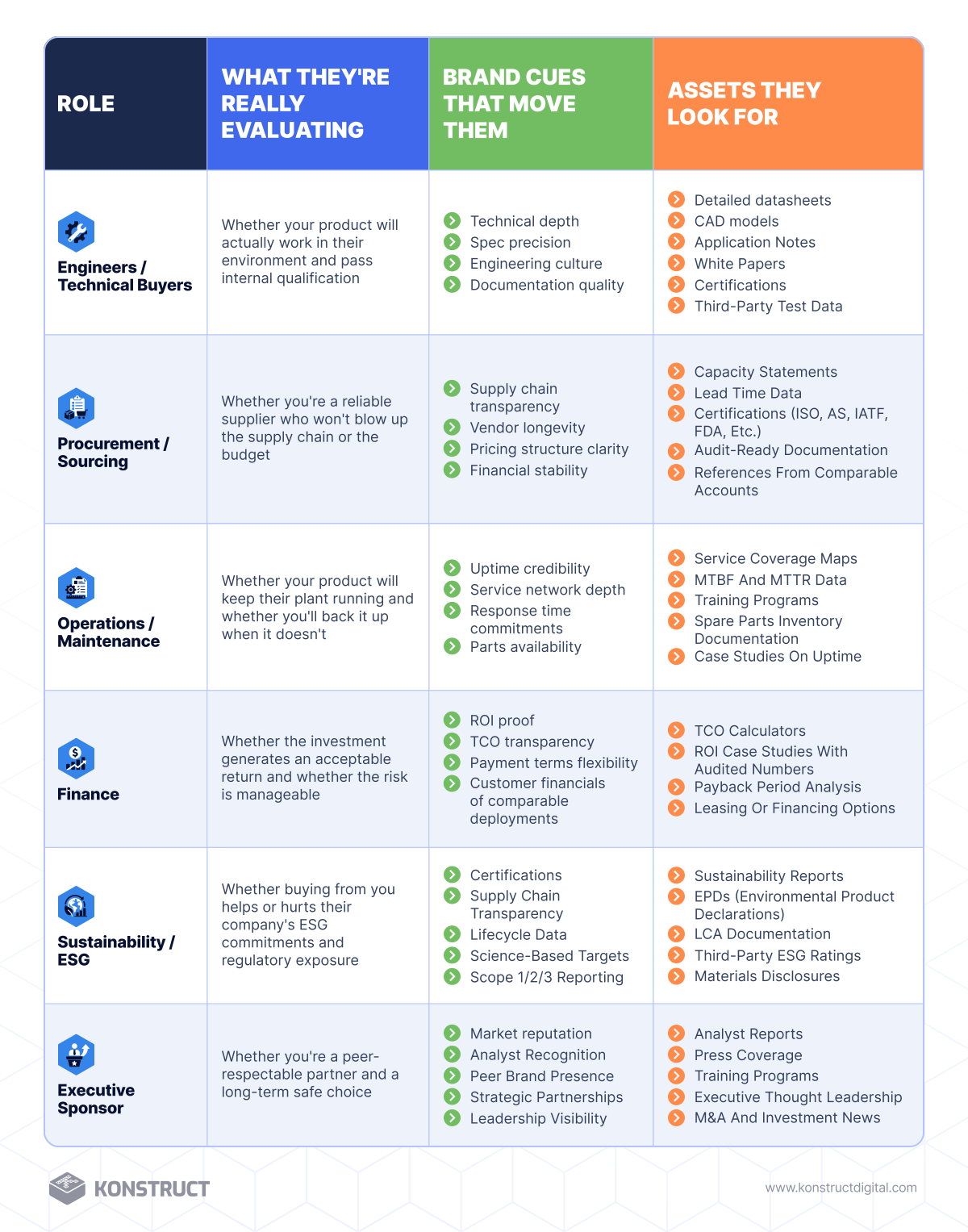
Each role wants different content, different proof, and different brand cues. None of them want generic “trusted partner” wallpaper.
What’s also clear: most manufacturers produce content and brand assets for one or two of these roles (usually engineers and procurement) and starve the other four. The CFO at your buyer’s company is looking for ROI case studies you never produced. The sustainability officer is looking for an LCA disclosure you haven’t published. The executive sponsor is looking for the analyst report you’ve never been mentioned in. You’re losing those stakeholders before the bid is even submitted, and you’re not losing them on price. You’re losing them on absence.
The obvious risk: if you try to be six different things for six different audiences, you stop being a brand at all. You become a cluster of disconnected campaigns wearing the same logo.
The discipline is to be one brand expressing the same positioning, with the same distinct assets, in tones and depths calibrated to each audience. Pfizer is a useful study here, even though the consumer association most people now have is recent (post-2020). Pfizer’s brand expression to a hospital procurement team is clinical, evidence-heavy, and supply-chain-credible. To a regulatory body, it’s rigorous and audit-ready. To a physician audience, it’s about clinical outcomes and patient stories. To a financial analyst, it’s about pipeline strength and capital allocation. Every one of those expressions is unmistakably Pfizer. The brand voice and assets carry the consistency while the content carries the audience-specific weight.
For a manufacturer, the practical translation is one positioning the whole company agrees on, one distinct asset system that shows up everywhere, content tracks calibrated to each buying group role on top of that shared foundation, and sales enablement that lets reps lead with the right content for the right stakeholder at the right time. That last part matters more than most marketing leaders give it credit for. The sales team is the runtime engine of brand expression for individual buying group members. If a rep walks into a meeting with a CFO and pitches the same deck they used with the controls engineer, the brand fails in the room regardless of how good the marketing assets were.
In almost every multi-stakeholder B2B purchase, you’ll have a champion (someone inside the buying group actively advocating for you) and one or more skeptics (stakeholders leaning toward an alternative, the incumbent, or no decision at all).
Most manufacturer marketing is optimized for the champion. The thinking is that an energized champion will drag the rest of the buying group along. That model is mostly outdated. Modern B2B research from Gartner has shown for years that the champion can pull a deal forward only as far as the most skeptical decision-maker will allow. If your brand hasn’t done credible work to neutralize the skeptic, the champion’s effort plateaus, the deal stalls, and you lose to either a competitor or a “no decision” outcome.
Brand at the buying group level isn’t about energizing the champion. It’s about giving the champion the brand assets they need to bring the skeptic on board. The content, the proof, the messaging, and the tone of voice all have to function on the most skeptical stakeholder, not just the most enthusiastic.
The manufacturers that get this right are the ones whose brand is being talked about inside their buyer’s organization between meetings, by people the rep has never met, using language the marketing team wrote. That’s how a brand actually moves through a 6-to-20-person buying group. Not by yelling louder at the champion. By making it easier for the champion to bring everyone else along.
Most “how to build your brand” articles are 5-step lists that look like they were written by someone who’s never actually run a brand program inside a manufacturing company. The steps are right (or right-ish) but they’re decontextualized from the rest of the marketing and revenue engine the brand has to function inside.
At Konstruct, we organize this work through the GTR (Go-To-Revenue) operating system. The OS includes six interlocking playbooks: Performance Branding, Demand Generation, Demand Capture, Sales Acceleration, Marketing Intelligence, and Data & MarTech. It treats marketing as one integrated engine rather than a list of channel tactics. Brand sits inside that engine as the Performance Branding playbook, but it threads through the rest of the system: Marketing Intelligence informs it, Demand Generation and Demand Capture deploy it, and Sales Acceleration extends it into the room with the buying group.
The six steps below take a manufacturer from “we don’t really have a brand” to “we have a brand that holds its value over time.” Each step depends on the one before it. Skip a step and the work downstream gets less defensible.
This is the step every competing article skips, and it’s why most manufacturer brand projects fail.
Before any positioning conversation, before any creative brief, before anyone opens a design tool, the work starts with intelligence gathering. The questions to answer first:
This phase is also where the business case to the CFO gets built. You can’t make a credible argument for brand investment until you can point at a specific gap in mental availability, a specific competitor occupying a position you want, or a specific stage of the buyer journey where your brand absence is costing measurable revenue.
Section 3 covered the positioning work in depth. The step in the process is simple: do that work using Dunford’s five-component framework, document the answers, and get cross-functional alignment (sales, product, leadership, marketing) before any creative work starts.
This step gets violated constantly because positioning conversations are uncomfortable. They force a company to admit what it isn’t, who it isn’t for, and what it won’t pursue. Design work is comfortable because it feels productive. So manufacturer brand projects routinely race to design while positioning is still ambiguous, and the design work absorbs the ambiguity. Two years later, the new brand still doesn’t say anything sharp, because there was nothing sharp to say.
The deliverable at the end of this step is a completed positioning canvas (the five Dunford components, each with documented answers and supporting evidence) and a positioning rationale document explaining why this position, why now, and what proof supports it. Both get signed off by senior leadership before any agency or in-house team starts opening files.
This is the step most agencies want to start with and the step most clients enjoy most, which is why discipline at this stage matters. The work breaks into the four asset categories from Section 4:
In-house, agency, or hybrid is the wrong fight at this stage. The right question is whether the team building each asset has the depth to do it once correctly, because the cost of fixing a poorly-built brand system three years later is materially higher than building it right the first time.
A brand is only as strong as its consistent deployment across the channels where your buying group spends time. For manufacturers, that surface area is wider than most marketing leaders treat it as:
Deploy with intent. Not everywhere at once, and not just where it’s easy. Deploy where the buying group already is, in the formats they already consume, with the depth their role requires.
This is the step that separates manufacturers who have a real brand from manufacturers who have brand documentation.
A brand only works if the people inside the company can deploy it consistently:
Caterpillar didn’t build “Cat Yellow” by writing a brand guideline document. They built it by enforcing the standard, decade after decade, across every product, every dealer, every uniform, every brochure, every press release, every trade show booth, and every conversation that came out of the company. Operational discipline is what makes a brand asset hold its value. The absence of it is what makes brand investment evaporate.
Brand isn’t a project. It’s a long position. The work pays off best when you hold the line for years, not quarters, although (as Section 2 noted) short-term effects are real and visible inside the first one to two years.
The mistake most manufacturers make at this stage is changing too much, too often, in response to internal politics and external noise. A new CMO arrives and wants to “freshen the brand.” A new agency relationship triggers a “new visual direction.” A competitive launch creates pressure to “respond.” Each of those interventions, individually, is defensible. Stacked over five or ten years, they destroy the asset.
The discipline of staying the course:
Manufacturers who hold the brand line for ten or twenty years end up with a position that becomes uneconomic for competitors to challenge. That’s the prize at the end of the long position.
Every brand measurement article ends in the same place: “track brand awareness and recall through quarterly surveys.”
This is performance theater. Brand awareness surveys are expensive, the response data is noisy, the lift from one quarter to the next is rarely statistically significant on a sample size most manufacturers can afford, and the resulting deck gets nodded at in the QBR before everyone goes back to talking about pipeline. Surveys aren’t the problem (well-run surveys do have a place), but they’re the wrong place to anchor a measurement program. They’re the equivalent of measuring whether your sales team is improving by asking the team if they feel better about their job.
There’s a better way to measure brand in manufacturing. It requires accepting some hard truths about attribution upfront, building a measurement framework that respects the long buying cycle, and pointing at metrics that are visible inside the systems you already run.
That last point matters more than most. The reason brand budgets lose at the budget meeting isn’t because brand doesn’t work. It’s because the data showing brand is working never gets surfaced to the people writing the check.
A bit of honesty before the framework. Measuring brand impact in manufacturing is harder than measuring it in almost any other category, for three reasons:
None of this is a reason to give up on brand measurement. It’s a reason to measure differently. The right framework leans on leading indicators that are observable, mid-funnel signals that are causally close to brand work, and lag indicators that confirm the long position is paying off. Critically, the leading and mid-funnel indicators move within months, not years. Brand impact isn’t only visible on a multi-year horizon, and a measurement framework that operates as if it were is what keeps brand budgets from ever getting approved.
I work from a three-tier framework with manufacturing clients. Tier 1 is leading indicators (brand is producing the signals you’d expect it to). Tier 2 is mid-funnel evidence (brand is changing how buyers behave inside your pipeline). Tier 3 is lag indicators (brand is moving the financial outcomes the CFO actually cares about).
The where and how for each metric is named alongside it. None of these require exotic infrastructure.
Tier 1: Leading Indicators (Months 0 to 6)
Tier 2: Mid-Funnel Evidence (Months 6 to 18)
Tier 3: Lag Indicators (Months 12 to 36)
Across all three tiers, the discipline is to measure the same metrics consistently over time and look at trend lines, not single-quarter snapshots. Brand moves slowly, but it does move within months. Reading one quarter of data and concluding “brand isn’t working” is the most common measurement mistake in the industry.
A short list of things that show up in manufacturer marketing dashboards constantly and shouldn’t:
The pattern across all four: easy to measure, easy to put on a slide, disconnected from the buying group behavior that actually produces revenue.
Before the framework above turns into a CFO conversation, two things have to be said out loud. The marketing leaders who say them stay credible. The ones who don’t lose the room on the first hard question.
The CRM is built to capture the touchpoints that happen after a buyer raises their hand. Brand’s job is to be the reason they raised their hand in the first place, and that work happens months or years before the lead source field gets populated. Attribution systems systematically under-credit brand and over-credit the last touch before the form fill. That’s a feature of how measurement systems are built, not a flaw of brand. The right response isn’t to argue with attribution. It’s to triangulate across the three tiers above, present trend data over the right time horizons, and explicitly call out the gap between what the CRM shows and what the broader signal set demonstrates.
In theory, it can. If you add brand investment to a marketing program where nothing else changes (no new SDRs, no new campaigns, no shifts in sales motion, no content refreshes, no competitor moves, no macroeconomic noise), the delta in your metrics is attributable to brand. That’s the lab-experiment answer, and it’s intellectually honest.
In practice, the lab experiment is impossible to run. Nothing holds still over the 12 to 36 months brand actually needs to produce results. Markets shift. Competitors move. Sales hires happen. Content gets refreshed. Ad budgets fluctuate. Even if you hold your own marketing constant, the world outside doesn’t cooperate.
So the working reality is this: the metrics in the three tiers above will move intentionally because of brand work. They will also move as a byproduct of other marketing efforts. Demand generation campaigns, demand capture activity, sales acceleration plays, and operational improvements all leave traces on the same metrics over the same period. Branded search volume goes up when brand investment increases. It also goes up when a targeted LinkedIn campaign drives a wave of new audiences to look you up. RFP inclusion rate climbs when your brand presence grows. It also climbs when sales hires more SDRs and works more accounts into the funnel.
Once you accept that the sterile lab experiment is unavailable, attributing every movement in these metrics to brand investment in isolation isn’t just methodologically hard. It’s the wrong question to be asking in the first place.
The right question is whether the entire marketing program is producing the leading indicators, the buyer behavior change, and the financial outcomes you projected for the budget you spent. Brand is one input. Demand generation is another. Demand capture is another. Sales acceleration is another. They all amplify each other when the program is working, and they all suffer when one of them is missing. Trying to isolate brand from the rest of the system is like trying to measure how much of a meal’s flavor comes from the salt.
This is the underlying logic of the GTR OS. The Performance Branding playbook isn’t evaluated against pipeline ROI by itself. It’s evaluated alongside the Demand Generation, Demand Capture, Sales Acceleration, Marketing Intelligence, and Data & MarTech playbooks as one integrated revenue engine. The metrics above tell you whether the brand playbook is doing its job inside that engine. The judgment about whether the engine as a whole is producing the right output is a portfolio-level conversation.
When the brand budget comes up in a planning meeting, the marketing leader who’s done the measurement work walks in with three things, framed against the marketing program as a whole rather than brand in isolation:
The conversation moves from “trust me on brand” to “here is the data showing the marketing program is producing the signals we’d expect, the buyer behavior change we’d expect, and is on track for the financial impact we projected. Starving any playbook in the program degrades the rest.” That’s a conversation a CFO can fund.
Without that framing, every brand budget conversation defaults to the easier (and unfair) comparison: brand vs. paid search clicks the CFO can see in the dashboard tomorrow. Brand loses that comparison every time, not because it’s worse, but because it’s evaluated in isolation. The path to a defensible brand budget is to stop arguing about brand ROI and start defending the effectiveness and efficiency of the marketing program as a whole. The brand playbook wins on the merits when the whole engine is evaluated together.
Eight failure patterns that show up in manufacturer brand programs over and over. None are new. Most are touched on elsewhere in this article. They’re collected here because the sins of manufacturing branding are easier to recognize when they’re named directly and sitting next to each other.
If you find yourself nodding at three or more of these, the brand work in your organization needs more than a refresh. It needs a reset.
If your tagline could be cut and pasted onto any competitor’s website without anyone noticing, it isn’t a tagline. It’s wallpaper. Same goes for any combination of “trusted partner,” “best-in-class,” “engineered for excellence,” “your one-stop shop,” and the rest of the manufacturer-cliché bingo card.
These phrases aren’t positioning. They’re an admission that no positioning decision has been made.
The fix: do the work in Section 3, then write a tagline that holds up the resulting position. Or skip the tagline entirely until the position is real. A blank space under your logo is better than meaningless filler.
A new logo and a new color palette are the most visible outputs of a brand project, which is why they’re the ones that get prioritized. Two years and several hundred thousand dollars later, the company looks different, behaves the same, says the same things to the same audiences, and wonders why nothing changed. This happens whether the project was framed as a rebrand or as a first-time brand build.
Logo-led brand projects fail because they treat brand as a creative asset rather than a strategic position. The new logo expresses the same un-positioned company.
The fix: positioning before design. Always. If the leadership team can’t agree on what the company should stand for and who it should stand for, fix that first. Then commission design that expresses the answer.
Walk through any manufacturer’s website right now and you’ll see the same five photos: the close-up of a worker’s gloved hand operating a machine, the wide shot of a clean factory floor, the welding spark, the engineer in safety glasses pointing at a diagram, the conference room with diverse stakeholders looking at a laptop.
Those photos cost real money. They also tell your buyer absolutely nothing about you, because they’re sitting on hundreds of your competitors’ websites in slightly different configurations. Stock photography is anti-distinctive by definition. It’s the visual equivalent of “quality, reliability, innovation.”
The fix: commission actual photography of your actual people, products, and facilities, directed by someone who understands your brand voice. When the budget for that isn’t there, AI image generation (Midjourney, Adobe Firefly, DALL-E, and others) has become a viable middle ground: cheaper than a custom shoot, more brand-distinctive than stock, as long as someone with a brand eye is directing the prompts and curating the outputs. The point is to end up with imagery that looks like your company instead of imagery that looks like a stock library.
Most manufacturer booth design is outsourced to the booth company by default, because the booth company has the modular systems, the labor crews, and the shipping infrastructure. The brand team’s involvement starts and ends with sending a logo file.
The result is predictable. The booth looks like every other booth on the floor that the same booth company built, with your logo on it. The most concentrated brand impression opportunity in your category is wasted on a generic structure with branded vinyl on the back wall.
The fix: the booth is brand expression first and a logistics problem second. Brand and marketing leadership should be in the booth design conversation before the booth company is selected. The booth needs to look like your brand, not like a booth.
Marketing builds a brand system. The sales team ignores it because the marketing-approved deck “doesn’t work in the room.” A rep pulls together a Frankenstein deck from three previous quarters of slides, adds their own talk track, and presents to a prospect who has been told to expect the company described on the website. The prospect sits through a presentation by a company that bears no obvious relationship to that website.
The brand is now two brands. The buyer chooses neither.
The fix: brand work has to extend into sales enablement, or it’s a marketing-only initiative. Sales decks built on the same design system. Talk tracks that reinforce the same positioning. A documented set of approved templates that make the on-brand path easier than the off-brand path.
Many manufacturers rely on distributor or rep networks to sell. Many of those distributors do their own marketing using product photos and specs pulled from the manufacturer’s website, with the distributor’s logo on top and the manufacturer’s brand reduced to a small reference at the bottom of the page.
Net result: the buyer remembers the distributor and forgets the manufacturer. The brand investment was real. The brand impression went to someone else.
The fix: a real distributor brand program. Templates that maintain manufacturer brand prominence. Co-marketing standards that channel partners actually follow because the templates make compliance easier than non-compliance. Training so the people building the co-marketed assets understand why the standards exist.
A new CMO arrives. A new agency is hired. The brand gets “refreshed.” Three years later, another new CMO, another agency, another refresh. Each cycle costs money. Each cycle resets the asset base. The distinct brand assets the company spent years building get thrown out and replaced with new ones that haven’t earned recognition yet.
Brand isn’t a project. It’s an operating system that runs every day after the project is done. Manufacturers who treat it as a project keep restarting the clock on their own mental availability.
The fix: build the brand, then enforce it. The asset system has an owner inside the company. The standards get maintained across leadership transitions. The brand outlives the people who built it.
A surprising number of manufacturer brand projects are run by agencies and consultants who never directly interview a single member of the buying group. They work from internal stakeholder interviews, secondary research, and the manufacturer’s existing customer data. The brand strategy that comes out the other end reflects what the manufacturer believes about its buyers, not what the buyers believe about the manufacturer.
This is how brand projects produce work that everyone inside the company loves and no buyer responds to.
The fix: insist on direct buyer research as part of any brand engagement. Not focus groups. Not customer satisfaction surveys. Structured interviews with members of the buying group across won, lost, and never-engaged accounts. The voice-of-customer data is what makes the rest of the work defensible.
None of these mistakes is fatal on its own. Most manufacturers are committing at least three at any given time. The damage comes from the accumulation. Each one leaks a little brand value. Stack them across five years and the brand investment that was supposed to build into something durable never gets the chance to start.
The fixes are mostly cheap. The decisions are mostly uncomfortable. That’s why the mistakes persist.
Brand isn’t urgent the way a missed quota is urgent. It doesn’t ring a bell when it slips. There’s no Monday morning meeting where someone asks why mental availability declined two points last week. The deals you don’t get invited to bid on don’t show up in your CRM. The buyers who never think of you don’t fill out your contact form.
That’s the entire problem.
Most strategic underinvestments in manufacturing aren’t underinvestments because nobody knows the work needs to happen. They’re underinvestments because the work has no due date and no visible cost of delay. Brand is the most consequential example of this pattern in the entire marketing program. Every quarter without serious brand investment costs your company something. The cost is just invisible.
Here’s the part that should keep a senior marketing leader up at night. You don’t know which of your competitors decided this year to take brand seriously. Not until the recognition curves have already diverged.
By the time you can feel a competitor’s brand pulling shortlist position away from you, they’ve had a two-to-three-year head start. The data shows up in branded search trends, in trade press mentions, in your sales team reporting more “they already chose someone else” outcomes on RFPs. By then, the easy share is gone. The competitor you couldn’t see is now the brand position you can’t catch.
The manufacturer one or two doors down might already be on quarter four of a serious brand program right now. Or might be about to start. Or might already have committed to one and just hasn’t broadcast it. None of those scenarios are visible from your QBR.
For the marketing leader trying to make the case internally, three specific costs are worth naming. These aren’t five-year hypotheticals. They’re costs being paid right now, in the current fiscal year, by manufacturers without a deliberate brand.
Margin compression. Premium pricing requires a brand strong enough to support it. Every quarter your brand can’t carry the price, you’re discounting to win or losing on price. That margin is real money, and it shows up in the financials the CFO actually watches. The longer the brand stays under-invested, the harder it is to recover pricing power once a competitor takes the premium position.
Sales productivity decay. Reps in companies with weak brands work harder to win every deal. They spend more cycles explaining who the company is, more time defending against unknown competitors, and more rounds on each negotiation. That productivity drag scales with every additional rep you hire. Brand isn’t just a marketing function. It’s a sales force multiplier (or a tax, depending on which side of the recognition curve you’re on).
Recruiting cost. Strong brands attract talent at a discount. Weak brands pay a premium for the same caliber of hire, because every candidate has to be sold on the company before they accept. For manufacturers competing for engineering, technical sales, and operational talent against companies with stronger brands, the recruiting math is brutal. You’re not just losing customers to a weak brand. You’re losing the people who would build the next decade.
The decision in front of you isn’t “should we invest in brand someday.” It’s “are we comfortable with a competitor owning our category five years from now.”
Those two questions sound different. They are the same question.
The manufacturers that look at the second version honestly tend to invest. The ones that frame it as the first tend to defer it for another quarter, then another, until they wake up one day and realize the category-defining brand position has been taken. By that point, the work to recover is materially more expensive than the work to claim it would have been.
Standing still on brand is a strategic choice. It’s just usually made by accident, in a series of small budget decisions that each felt defensible at the time. Everything in this article is an argument for making the choice deliberately, with the math visible, before the easy half of the window closes.
If you’ve read this far, you’ve already done part of the hard work. The harder part is what happens on Monday morning.
The honest truth is that most manufacturers who agree with everything in this article still won’t act on it. Brand competes against more urgent, more measurable, more emotionally satisfying line items every budget cycle. The arguments above are correct. They’re also slow-acting in the long run, even if (as Section 1 covered) the short-term effects are real. The marketing leader who internalizes them and then has to defend them in an executive meeting next week is the one who decides whether this becomes the year your brand finally got built or the year it kept getting deferred.
Two paths from here, depending on where your organization is.
Before you commit to any new budget or any new engagement, run the framework in this article against your own brand:
That five-step audit is enough to walk into a budget conversation with a more honest case for brand than 90% of manufacturer marketing leaders bring.
Brand work is some of the highest-stakes strategic work a manufacturer can take on, and it’s also the kind of work where outside perspective tends to be worth the investment. The whole point of an outside partner is to bring direct buying group research, competitor brand audit experience, and the discipline to do positioning work without flinching, before any design starts.
At Konstruct, we run brand strength analyses as part of our manufacturing engagements, as prescribed by our GTR methodology. The output is a defensible business case for what to do next, grounded in the kind of measurement framework described earlier in Section 7.
If that sounds like the conversation you should be having before the next planning cycle, you can read more about Konstruct and our GTR operating system here.
Most manufacturers are one or two strategic decisions away from a brand that holds its value for the next decade. The decisions are uncomfortable, the work is slow, and the payoff sits on the far side of a budget cycle most companies aren’t patient enough to fund.
The ones who do the work anyway are the ones who own their category five years from now.
Make the case. Defend the budget. Do the work.